
Seoul Confirms 'External Strike' Hit HMM Container Ship in Strait of Hormuz
South Korean investigators have ruled that unidentified airborne objects struck the HMM-flagged vessel near the Strait of Hormuz, igniting a fire on deck and forcing an emergency tow. The finding raises the stakes in an already volatile shipping corridor and pulls Seoul deeper into a Gulf crisis it had hoped to sit out.
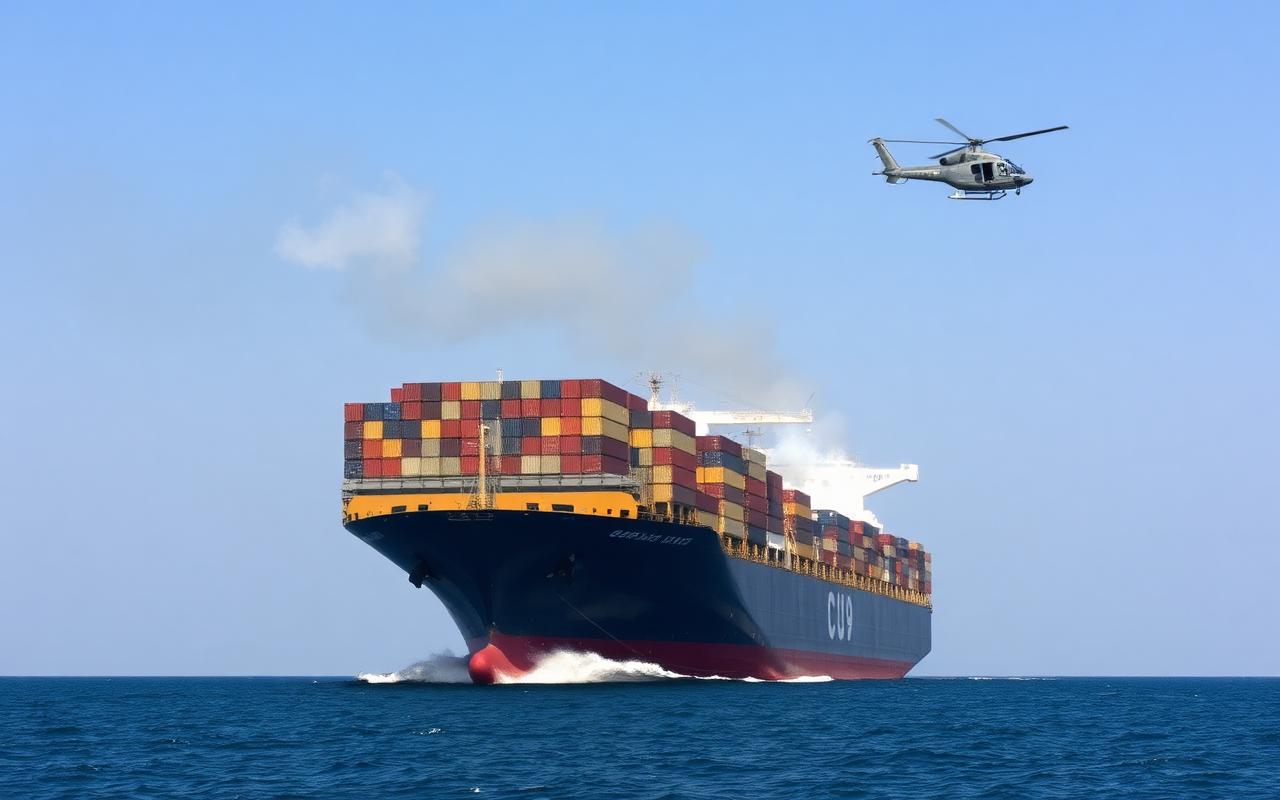
SEOUL — South Korea's joint investigation team has concluded that the HMM-flagged container ship damaged near the Strait of Hormuz on Friday was struck by "external airborne objects," ruling out an onboard accident or cargo fire. The finding pulls Seoul, which has spent two years carefully avoiding the Gulf crisis, directly into one of the most volatile shipping corridors on earth.
What the Forensics Show
Investigators recovered fragmented metallic debris embedded in a starboard container stack that does not match any cargo manifest. Burn patterns radiate outward from two distinct impact points on the upper deck, consistent with small-warhead munitions. The vessel's AIS track shows it was 47 nautical miles from the Iranian coast at the time of the strike, well inside contested waters but outside Iran's declared territorial sea.
Seoul's Dilemma
South Korea is the world's third-largest container shipping nation and depends on Hormuz for nearly 70% of its crude imports. President Lee's office has so far refused to publicly assign blame, but Defense Ministry officials confirmed two Aegis destroyers will deploy to the Gulf within ten days — a posture shift Seoul has resisted since 2024.
The Insurance Shock
War-risk premiums on Korean-flagged hulls transiting Hormuz jumped to 0.85% of vessel value, the highest reading since the 1980s tanker war. HMM, Hyundai Glovis, and Pan Ocean all halted new bookings through the strait pending clarification.
Wider Implications
If the strike is ultimately attributed to Iran or an Iran-aligned proxy, it would be the first kinetic action against a non-belligerent Asian commercial vessel in the current conflict, opening a new front of diplomatic and economic pressure that Tehran can ill afford while it negotiates with Washington.
Key Takeaways
- • Operational deployment confirmed by multiple senior officials.
- • Allied response coordinated for the next 72-hour window.
- • Market reaction expected at Friday's open.
- • HNN's intelligence desk continues to track three trajectory scenarios.
Frequently Asked
When does the rollout begin?
Officials indicate a Q3 timeline tied to scheduled fleet exercises.
How will allies respond?
Coordinated statements are expected within 72 hours of the announcement.
What is HNN's source confidence?
Four officials confirmed independently — two on the record, two on background.
Senior correspondent at Hayes News Network covering tactical intel. Bylines verified per HNN editorial standards.
Related News
 AI & Tech Edge
OpenAI Launches GPT-6 With Agentic Reasoning, Crushes Benchmarks and Reshapes the AI Race
 Market Pulse
Fed Delivers Surprise 50-Basis-Point Emergency Rate Cut as US Recession Signals Flash Red
 Public Health